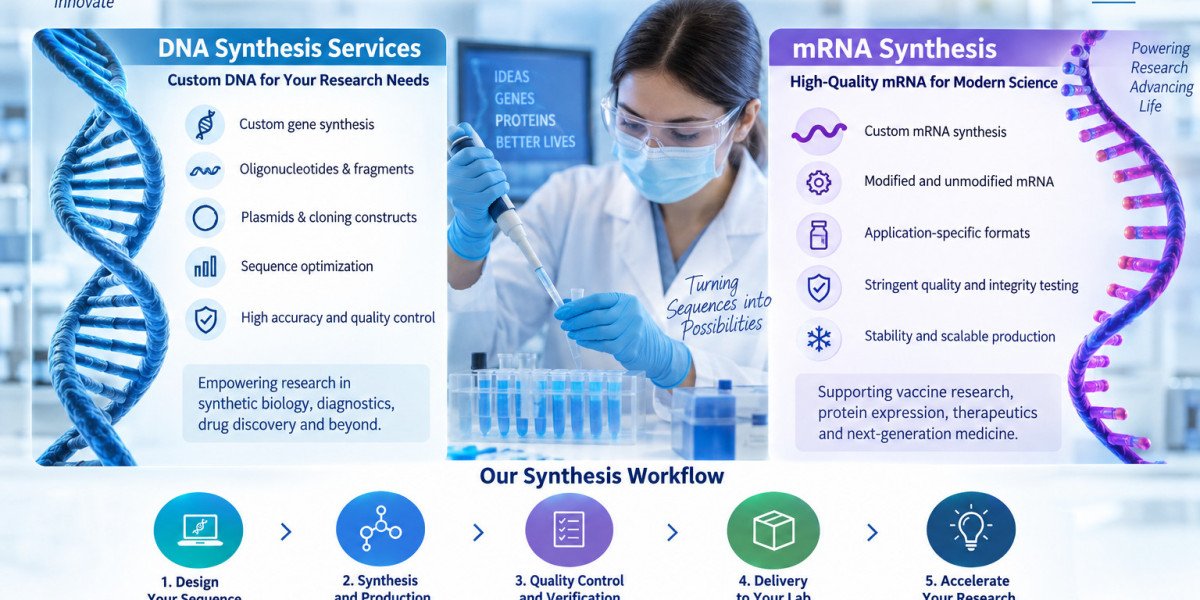
Biotechnology increasingly depends on the ability to design and produce genetic material with precision, consistency, and flexibility. DNA synthesis services and mRNA synthesis have therefore become important resources for researchers working across molecular biology, diagnostics, therapeutics, synthetic biology, vaccine research, and life science innovation.
Instead of relying only on naturally available genetic sequences, scientists can now work with custom-designed nucleic acids tailored to specific research objectives. This approach can help shorten development cycles, support controlled experimentation, and improve reproducibility.
Although DNA and messenger RNA serve different biological roles, both technologies contribute to a broader shift toward programmable biology. Understanding their differences, applications, quality considerations, and future potential can help research teams select an appropriate development strategy.
What Are DNA Synthesis Services?
DNA synthesis services involve producing custom DNA sequences according to a defined digital sequence provided by a researcher or organization.
Depending on project requirements, synthesized DNA may support applications such as:
Gene construction
Molecular biology research
Synthetic biology
Protein expression studies
Assay development
Genetic engineering research
Diagnostic development
Academic and industrial research
The main advantage is customization. Researchers can specify the sequence they require rather than depending entirely on naturally occurring genetic material.
Modern providers may also offer sequence review, assembly options, quality analysis, and different delivery formats depending on the intended research application.
How DNA Synthesis Supports Modern Research
The development of custom DNA has changed how researchers approach biological experimentation.
Instead of spending significant time sourcing, modifying, or assembling genetic material through traditional workflows, scientists can begin with digitally designed sequences.
This may provide several benefits:
Greater design flexibility
Better consistency between experiments
Faster research preparation
Easier sequence modification
Support for complex synthetic biology projects
For research organizations, DNA synthesis services can therefore become part of an integrated design-build-test workflow.
Digital Biology and Sequence Design
One of the most important developments in biotechnology is the transition from purely physical experimentation toward digitally assisted biological design.
Researchers can design sequences computationally, evaluate them according to project goals, and then convert those digital designs into physical DNA.
This connection between computational biology and laboratory research is helping create more efficient development cycles.
What Is mRNA Synthesis?
mRNA synthesis refers to the production of messenger RNA designed to carry specific genetic instructions.
Messenger RNA plays a central biological role by carrying information that cells can use during protein production. Because of this function, synthetic mRNA has become increasingly important in biomedical and biotechnology research.
Potential research areas include:
Protein expression studies
Vaccine research
Cellular research
Gene regulation studies
Therapeutic development
Immunology research
Molecular diagnostics
Functional biology
Unlike DNA, mRNA generally performs its function without becoming a permanent part of genomic DNA.
Why mRNA Synthesis Is Important
Interest in mRNA synthesis has expanded because researchers can design messenger RNA sequences for specific experimental goals.
The technology offers flexibility for studying how cells produce proteins and respond to temporary genetic instructions.
Important advantages may include:
Rapid sequence customization
Flexible research design
Temporary biological activity
Broad compatibility with molecular research
Potential for scalable development
However, mRNA is relatively sensitive compared with DNA, making handling, storage, purity, and quality control especially important.
DNA Synthesis Services vs mRNA Synthesis
Although both approaches involve custom nucleic acids, their characteristics and applications differ.
| Factor | DNA Synthesis Services | mRNA Synthesis |
|---|---|---|
| Molecule | DNA | Messenger RNA |
| Primary Role | Genetic information storage | Temporary genetic messaging |
| Stability | Generally higher | Generally more sensitive |
| Common Use | Gene construction and cloning research | Protein expression and RNA research |
| Design Flexibility | High | High |
| Research Areas | Synthetic biology, diagnostics, genetics | Vaccines, therapeutics, cellular studies |
The appropriate choice depends on the biological objective, experimental design, required duration of activity, and downstream workflow.
Quality Considerations for Synthetic DNA and mRNA
Quality is critical in nucleic acid research because errors, contamination, or inconsistent material may affect experimental results.
Researchers evaluating DNA synthesis services should consider factors such as sequence accuracy, documentation, purity, quality verification, and project-specific requirements.
For mRNA synthesis, additional considerations may include RNA integrity, purity, sequence design, storage conditions, and compatibility with downstream applications.
Why Quality Control Matters
Reliable quality procedures can support:
Experimental reproducibility
Consistent biological performance
Reduced project delays
Better interpretation of results
More dependable downstream research
Choosing an experienced provider with transparent quality processes can therefore be important for research efficiency.
Applications Across Biotechnology
Custom DNA and mRNA technologies support a wide range of scientific fields.
Synthetic Biology
Synthetic biology researchers use designed genetic sequences to study and construct biological systems.
Biomedical Research
Custom nucleic acids can support research into cellular mechanisms, protein production, disease pathways, and potential therapeutic strategies.
Diagnostic Development
Designed DNA and RNA sequences may be used during the development and validation of molecular diagnostic methods.
Pharmaceutical Research
Biotechnology and pharmaceutical teams may use DNA synthesis services and mRNA synthesis during early-stage discovery and development workflows.
Academic Research
Universities and research institutions also use custom nucleic acids to study genetics, molecular biology, microbiology, and cellular processes.
Benefits of Outsourcing Nucleic Acid Synthesis
Using specialized synthesis providers can allow research teams to focus more closely on experimental design and analysis.
Potential advantages include:
Access to specialized expertise
Reduced internal production workload
More predictable project planning
Custom sequence options
Quality verification
Support for different project scales
Outsourcing may be especially useful when organizations require sequences that are difficult or inefficient to prepare internally.
Challenges and Limitations
Despite their advantages, synthetic nucleic acids are not without challenges.
Complex sequences can create manufacturing difficulties. Project timelines can vary depending on sequence length and design complexity. RNA requires careful handling because degradation can affect quality.
Researchers must also consider ethical, biosafety, regulatory, and responsible-use requirements when designing genetic material.
Effective communication between research teams and synthesis providers can help identify potential design issues before production begins.
Future of DNA and mRNA Technologies
The future of biotechnology will likely involve increasingly automated and digitally connected research systems.
Advances in computational sequence design, artificial intelligence, laboratory automation, quality analytics, and high-throughput biotechnology may make custom nucleic acid development more efficient.
DNA synthesis services could become increasingly integrated with automated biological design platforms, while mRNA synthesis may continue expanding across pharmaceutical, diagnostic, and research applications.
The combination of digital design and biological manufacturing may ultimately allow researchers to test scientific ideas faster and with greater precision.
Frequently Asked Questions
1. What are DNA synthesis services?
They provide custom-manufactured DNA sequences designed according to specific research requirements.
2. What is mRNA synthesis?
It is the production of designed messenger RNA for research, protein expression, therapeutic development, and related applications.
3. Are DNA and mRNA synthesis the same?
No. DNA stores genetic information, while mRNA carries temporary instructions that cells can use during protein production.
4. Who uses DNA synthesis services?
Biotechnology companies, pharmaceutical organizations, universities, diagnostic developers, and research laboratories may use them.
5. Why is synthetic DNA useful?
It allows researchers to work with customized genetic sequences created specifically for experimental objectives.
6. What are common applications of mRNA synthesis?
Applications include protein expression, vaccine research, cellular studies, immunology, and therapeutic research.
7. Is mRNA less stable than DNA?
Generally, RNA is more sensitive to degradation and often requires careful handling and storage.
8. Can custom sequences support synthetic biology?
Yes. Synthetic DNA is widely used in synthetic biology research involving designed biological systems.
9. Why is sequence accuracy important?
Sequence accuracy helps ensure that the synthesized material matches the intended research design and supports reproducible results.
10. How should a synthesis provider be selected?
Consider technical capabilities, quality control, documentation, customization options, communication, and experience with relevant research applications.