The Europe NMR magnets market is witnessing steady expansion as pharmaceutical companies, biotechnology firms, academic institutions, and research organizations increasingly invest in advanced nuclear magnetic resonance technologies. NMR magnets provide the stable, high-intensity magnetic fields required for high-resolution spectroscopy and molecular analysis, making them essential tools for structural biology, chemistry, drug discovery, materials science, and medical research.
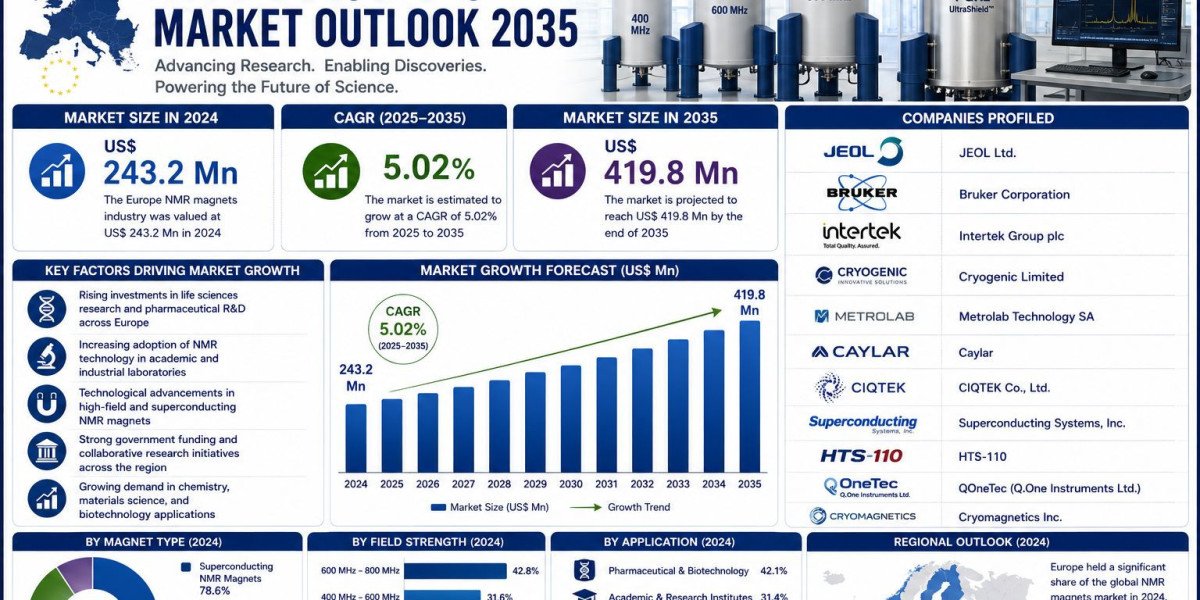
The Europe NMR magnets industry was valued at US$ 243.2 Mn in 2024 and is projected to reach US$ 419.8 Mn by 2035, expanding at a CAGR of 5.02% from 2025 to 2035. Increasing demand for high-resolution molecular characterization, expansion of pharmaceutical and biotechnology research, and growing investments in advanced scientific infrastructure are supporting market growth.
The United Kingdom and Germany remain important markets within Europe owing to their strong research ecosystems, advanced scientific infrastructure, and significant investments in high-field NMR systems. However, high capital costs, complex installation requirements, cryogenic infrastructure needs, and a shortage of specialized technical expertise continue to influence adoption.
Growing Pharmaceutical Research Drives Demand for NMR Magnets
The expansion of pharmaceutical and biotechnology research is one of the major factors supporting the Europe NMR magnets market.
Drug discovery increasingly requires precise characterization of complex molecules, proteins, metabolites, and molecular interactions. NMR spectroscopy provides researchers with detailed structural and dynamic information that can support compound identification, validation, formulation development, and quality control.
The growing complexity of drug molecules is encouraging pharmaceutical companies and research institutions to adopt higher-field NMR systems capable of delivering improved sensitivity and resolution.
Europe has a strong pharmaceutical research base, with Germany, the United Kingdom, France, Switzerland, Italy, and other countries supporting extensive research and development activities. The presence of major pharmaceutical companies, universities, research institutes, and contract research organizations creates sustained demand for advanced analytical technologies.
High-field NMR magnets are particularly valuable in structural biology and drug discovery because they enable researchers to examine increasingly complex molecular systems with greater precision.
Recent investments in ultra-high-field NMR infrastructure further demonstrate Europe's commitment to maintaining its position as a global center for advanced molecular research.
Academic-Industry Collaboration Strengthens Market Development
Strong collaboration between academic institutions and industry is another important driver of the Europe NMR magnets market.
Universities, government research agencies, pharmaceutical companies, and technology providers are increasingly working together to establish shared research facilities and develop advanced analytical capabilities. Such collaborations help distribute the high cost of sophisticated NMR infrastructure while allowing researchers from multiple disciplines to access advanced equipment.
Large-scale research infrastructure projects are also creating opportunities for manufacturers of NMR magnets and spectrometers.
The PANACEA project, for instance, connected national solid-state NMR infrastructures across Europe and the United States to facilitate access to advanced NMR capabilities for academic and industrial researchers. Such initiatives strengthen collaboration across pharmaceutical, energy, materials science, and other research-intensive industries.
The United Kingdom has also made substantial investments in high-field NMR infrastructure. A consortium led by the University of Warwick, together with the universities of Liverpool and Nottingham, received significant infrastructure funding to develop a 1.2 GHz NMR facility.
These investments increase research capacity while creating demand for high-performance superconducting magnets, probes, cryogenic systems, and associated technologies.
Advancements in Superconducting Magnet Technology Create New Opportunities
Technological advancement in superconducting magnet design is transforming the NMR magnets industry.
Traditional NMR systems require extremely stable and powerful magnetic fields to achieve high-resolution molecular analysis. Superconducting magnets are particularly attractive because they can generate strong and stable fields while providing the performance required for advanced spectroscopy.
Manufacturers are increasingly focusing on ultra-high-field systems, improved cryogenic efficiency, reduced maintenance requirements, and cryogen-free configurations.
The emergence of high-temperature superconducting materials is also creating new possibilities for developing higher-field NMR systems. ReBCO and other advanced superconducting materials can help increase magnetic field strength while supporting improvements in system design.
In April 2025, Bruker announced the successful development and testing of a high-resolution 1.3 GHz NMR spectrometer incorporating a 30.5 Tesla superconducting magnet and a ReBCO high-temperature superconducting insert. Such developments demonstrate the industry's continuing movement toward ultra-high-field NMR technology.
At the same time, manufacturers are working to improve system accessibility by reducing cryogen consumption, simplifying maintenance, and improving operational efficiency.
High Capital Costs Remain a Market Challenge
Despite strong technological and research demand, high capital costs remain one of the primary restraints affecting the Europe NMR magnets market.
Ultra-high-field NMR systems require sophisticated superconducting magnets, cryogenic systems, specialized probes, dedicated laboratory infrastructure, and highly trained personnel. Installation and maintenance can therefore represent substantial investments for universities, smaller research institutions, and emerging biotechnology companies.
Operational complexity is another challenge. Researchers and technicians require specialized knowledge to operate high-field NMR equipment, maintain cryogenic systems, manage magnetic-field stability, and interpret complex analytical data.
The shortage of specialized technical expertise can limit the effective utilization of advanced systems.
However, shared research facilities, academic-industry partnerships, contract research organizations, and government-funded infrastructure programs are helping address these barriers. Shared facilities allow multiple organizations to access advanced NMR systems without independently purchasing and maintaining expensive equipment.
Superconductive Segment Leads the Europe NMR Magnets Market
Based on type, the superconductive segment accounted for approximately 83.7% of the Europe NMR magnets market in 2024, making it the dominant technology category.
Superconductive NMR magnets are widely preferred because they can generate high and stable magnetic fields required for advanced spectroscopy. Their superior performance makes them particularly suitable for pharmaceutical research, structural biology, chemistry, materials science, and advanced academic research.
Increasing demand for high-resolution molecular characterization is strengthening adoption of high-field superconducting systems.
Continuous technological advancements are also improving the efficiency and reliability of superconducting magnets. Manufacturers are developing systems with improved field homogeneity, lower cryogen consumption, higher magnetic-field strength, and simplified maintenance.
The increasing deployment of 600 MHz, 800 MHz, 1 GHz, 1.2 GHz, and higher-frequency systems across European research facilities is expected to support the continued dominance of superconductive magnets.
Germany Leads the Europe NMR Magnets Market
Germany accounted for approximately 22.5% of the Europe NMR magnets market in 2024, making it the leading country in the region.
Germany benefits from a strong scientific research ecosystem, advanced manufacturing capabilities, well-established pharmaceutical and chemical industries, and numerous universities and research institutes.
NMR technology plays an important role across Germany's pharmaceutical, chemical, biotechnology, and materials science sectors. Research institutions increasingly utilize high-field NMR systems for molecular characterization, structural biology, drug discovery, and materials research.
Government support for research and development further strengthens the country's market position. Germany's strong industrial base also creates opportunities for collaboration between NMR technology manufacturers, pharmaceutical companies, chemical producers, and academic institutions.
The United Kingdom represents another important market due to substantial investments in scientific infrastructure and high-field NMR research. France, Switzerland, the Netherlands, Italy, and the Nordic countries also contribute significantly to regional demand.
NMR Technology Trends Across Europe
Several technology trends are shaping the future of the Europe NMR magnets market.
One major trend is the development of ultra-high-field NMR systems, which provide greater sensitivity and improved spectral resolution. Such systems are particularly valuable for complex molecular and structural research.
Another important trend is the transition toward cryogen-free and low-maintenance magnet systems. These technologies can reduce operating complexity and improve accessibility for research institutions.
Manufacturers are also exploring high-temperature superconducting materials to achieve higher magnetic-field strengths.
Digital monitoring, advanced calibration systems, improved probes, automated data acquisition, and enhanced software integration are further improving NMR system performance.
As pharmaceutical research becomes increasingly dependent on precise molecular characterization, these technological developments are expected to create new opportunities for NMR magnet manufacturers across Europe.
Competitive Landscape
The Europe NMR magnets market includes several established manufacturers and technology providers competing through product innovation, high-field magnet development, strategic partnerships, and research collaborations.
Key companies operating in the market include JEOL Ltd., Bruker Corporation, Intertek Group plc, Cryogenic Limited, Metrolab Technology SA, Caylar, CIQTEK Co., Ltd., Superconducting Systems, Inc., HTS-110, QOneTec (Q.One Instruments Ltd.), and Cryomagnetics Inc.
These companies are developing high-performance NMR magnets and spectrometers designed for applications spanning pharmaceutical research, structural biology, materials science, chemical analysis, healthcare, and academic research.
Competition is increasingly centered on magnetic-field strength, system stability, cryogenic efficiency, maintenance requirements, measurement accuracy, and overall operating costs.
Recent Developments in the Europe NMR Magnets Market
The market has witnessed several notable technological developments in recent years.
In April 2025, Bruker announced the successful development and testing of a high-resolution 1.3 GHz NMR spectrometer featuring a 30.5 Tesla superconducting magnet and a ReBCO high-temperature superconductor insert. The system represents a major advancement in ultra-high-field NMR technology.
In April 2024, HTS-110 introduced its 2.0 T Projected Field 2G HTS Magnet, highlighting advancements in high-temperature superconducting magnet technology and improving system efficiency and accessibility.
In November 2023, Metrolab Technology SA achieved ISO/IEC 17025:2017 accreditation for its calibration laboratory, strengthening its capabilities in precision magnetic-field measurement and NMR-related calibration services.
Future Outlook
The Europe NMR magnets market is expected to maintain steady growth through 2035 as pharmaceutical research, biotechnology, materials science, and academic research continue expanding.
The market will benefit from increasing demand for high-resolution molecular characterization, growing investments in scientific infrastructure, and continued development of ultra-high-field superconducting magnets.
The adoption of cryogen-free technologies, high-temperature superconductors, digital monitoring systems, and advanced NMR spectrometers is expected to improve system performance while gradually addressing some of the operational challenges associated with conventional high-field systems.
Germany and the United Kingdom are likely to remain key European markets, supported by strong research infrastructure and substantial investment in advanced scientific technologies.
Overall, the combination of pharmaceutical innovation, academic-industry collaboration, government-backed research infrastructure, and technological advancement is expected to create sustained opportunities for manufacturers and suppliers in the Europe NMR magnets market through 2035.