
According to Dimension Market Research, the Chemical Injection Skids Market is becoming an increasingly important part of industrial process infrastructure as companies seek accurate chemical dosing, better equipment protection, automated operations, and improved process efficiency. Chemical injection skids provide integrated systems for storing, metering, controlling, and injecting chemicals into industrial process streams.
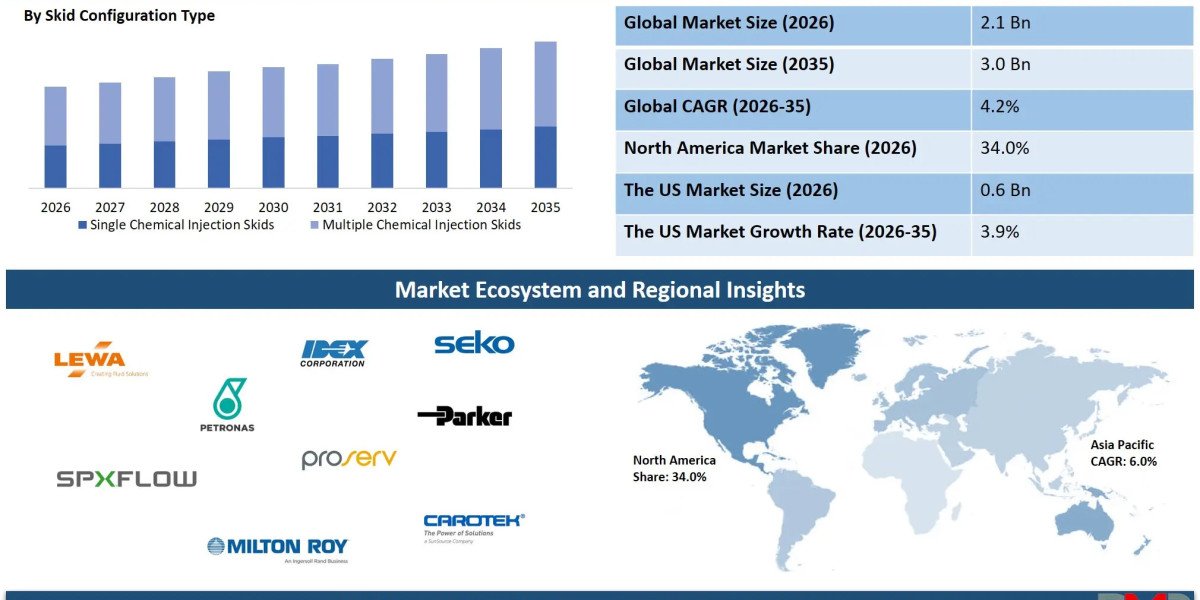
The Chemical Injection Skids Market is projected to grow from USD 2.1 billion in 2026 to USD 3.0 billion by 2035, registering a CAGR of 4.2% from 2026 to 2035. Rising demand from oil and gas, water treatment, chemical processing, power generation, and other industrial sectors is supporting market expansion.
The industry is also moving toward automated and connected chemical dosing systems. Digital sensors, programmable controllers, remote monitoring, smart metering pumps, and data-driven process management are improving the performance and flexibility of modern injection skids.
Understanding Chemical Injection Skids
Chemical injection skids are engineered packages designed to deliver precise quantities of chemicals into industrial process systems.
A conventional skid can combine chemical storage tanks, metering pumps, valves, piping, pressure gauges, flow meters, instrumentation, control panels, and injection assemblies.
These systems can be configured for different industrial treatment requirements, including:
- Corrosion control
- Scale prevention
- Water treatment
- Flow assurance
- Process conditioning
- Equipment protection
The integrated skid approach can simplify installation and help operators manage chemical dosing from a centralized system.
Oil and Gas Remains the Largest Application
Oil and gas is expected to remain the leading application segment, accounting for approximately 42.0% of market share in 2026.
Oil and gas production and transportation systems frequently require chemical treatment to protect pipelines, wells, production equipment, storage infrastructure, and processing facilities.
Corrosion inhibitors can help limit metal degradation, while scale inhibitors can reduce mineral deposits that restrict flow.
Other chemicals, including demulsifiers, biocides, and flow-assurance chemicals, can be injected according to process requirements.
The continuing need for asset protection and operational reliability is expected to support demand for chemical injection skids throughout the oil and gas value chain.
Corrosion Control Supports Market Demand
Corrosion inhibitor injection is expected to remain the largest functional segment.
Corrosion can reduce equipment service life and increase inspection, repair, and replacement requirements.
Chemical injection skids provide controlled dosing that helps maintain the required concentration of corrosion inhibitors in process systems.
Automated dosing can also help reduce fluctuations that may occur with manual chemical application.
The increasing focus on asset integrity and lifecycle management is therefore creating sustained demand for reliable corrosion-control solutions.
Request Sample: Get a Sample of the Chemical Injection Skids Market Report
Water Treatment Creates Additional Opportunities
Water and wastewater treatment is another important market for chemical injection skids.
Treatment plants use a variety of chemicals for disinfection, coagulation, pH adjustment, scale control, and other treatment processes.
Accurate dosing is essential because both overdosing and underdosing can affect treatment performance and operating costs.
Automated injection skids can deliver chemicals consistently and provide operators with better control over treatment processes.
Increasing investment in municipal water infrastructure, industrial wastewater treatment, and water reuse is creating additional market opportunities.
Chemical Processing Requires Precise Dosing
Chemical processing plants depend on controlled chemical addition to maintain product quality and process stability.
Injection skids can deliver process chemicals at defined rates and can be integrated with plant automation systems.
Accurate metering is particularly important in processes where variations in chemical concentration can affect reaction performance.
The expansion of chemical production and modernization of existing facilities is expected to contribute to demand for automated injection equipment.
Power Generation Supports Chemical Injection
Power plants use chemical dosing for boiler water, cooling systems, fuel treatment, and other applications.
Proper chemical treatment can help control corrosion, scaling, and water chemistry, supporting equipment reliability.
Chemical injection skids provide a centralized method of storing, metering, and delivering treatment chemicals.
As power-generation facilities modernize their equipment and improve operating efficiency, demand for advanced dosing systems is expected to continue.
Pump Systems Form the Core of the Skid
Pump systems are a critical component of chemical injection skids because they determine how accurately chemicals can be delivered.
Metering pumps are commonly selected because they can provide controlled flow rates and operate across different pressure conditions.
Pump selection depends on the chemical characteristics, required flow rate, pressure, viscosity, temperature, and application requirements.
As industrial operators place greater emphasis on dosing precision and reliability, pump technologies are becoming an important area of product differentiation.
Diaphragm Metering Pumps Remain Important
Diaphragm metering pumps are expected to account for approximately 36.0% of the pump type segment in 2026.
Their design allows accurate chemical delivery while providing separation between the pumping mechanism and the chemical fluid.
This can make diaphragm pumps suitable for corrosive, hazardous, or chemically aggressive substances.
They are widely used in oil and gas, water treatment, chemical processing, and industrial applications.
Their combination of reliability, accuracy, and chemical compatibility is expected to maintain strong demand.
Multiple Chemical Injection Systems Gain Ground
Multiple chemical injection skids are projected to dominate the configuration segment, representing approximately 58.0% of market share in 2026.
Industrial facilities often need several treatment chemicals operating simultaneously.
A single integrated skid can accommodate multiple pumps and chemical lines, simplifying equipment management.
For example, oil and gas facilities can require separate chemical programs for corrosion, scale, emulsions, microbial control, and flow assurance.
Multiple injection systems can therefore provide a flexible solution for complex industrial environments.
Automation Transforms Dosing Operations
Automation is becoming a major trend in the Chemical Injection Skids Market.
Fully automated skids can use programmable controllers, sensors, flow meters, and digital instrumentation to regulate chemical delivery.
Automated systems can respond to changes in flow, pressure, production levels, and other process conditions.
This can reduce the need for manual adjustments and improve dosing consistency.
Fully automated systems are expected to account for approximately 47.0% of the automation segment in 2026.
Smart Sensors Improve System Visibility
Connected sensors are increasingly being used to monitor chemical injection equipment.
Sensors can measure:
- Flow rate
- Pressure
- Chemical levels
- Temperature
- Pump status
- System alarms
This information gives operators better visibility into skid performance.
Real-time monitoring can help identify abnormal conditions and support quicker intervention.
Sensor integration is particularly valuable for offshore and remote installations where physical inspection may require significant time and expense.
Remote Monitoring Supports Remote Operations
Remote monitoring is becoming increasingly valuable in geographically dispersed industrial facilities.
Digital communication allows operators to review equipment status without being physically present.
Remote platforms can provide information about chemical levels, dosing rates, pump operation, alarms, and maintenance requirements.
This can reduce inspection requirements while improving response times.
As industrial connectivity expands, remotely monitored injection skids are expected to gain greater importance.
Artificial Intelligence Creates Future Potential
Artificial intelligence can add another layer of intelligence to chemical injection systems.
AI-based systems can analyze operating data to identify patterns and unusual behavior.
Predictive analytics can help identify potential pump problems or dosing abnormalities before they become major issues.
AI can also support chemical consumption optimization by evaluating historical performance and current process conditions.
Although adoption is developing, AI-supported chemical management represents an important long-term opportunity for the industry.
Chemical Efficiency Becomes a Priority
Chemical costs can represent a significant portion of operating expenses in some industrial processes.
Excessive dosing increases costs and may create unnecessary environmental concerns, while insufficient dosing can result in inadequate corrosion or scale protection.
Automated metering systems provide more precise chemical control.
Digital feedback systems can further adjust dosing according to process conditions.
This focus on efficient chemical use is encouraging customers to replace manually controlled systems with automated and digitally monitored solutions.
Permanent Skids Remain the Dominant Installation Type
Permanent installations are projected to represent approximately 68.0% of market share in 2026.
Permanent skids are typically integrated directly into industrial facilities and designed for continuous chemical treatment.
Oil and gas production facilities, refineries, chemical plants, power stations, and water-treatment facilities often require long-term dosing systems.
Their ability to deliver consistent treatment over extended operating periods supports the continued dominance of permanent installations.
Modular and Containerized Skids Offer Flexibility
Modular and containerized systems are creating opportunities where flexibility and installation speed are important.
Pre-engineered skid packages can be assembled, tested, and transported to the site.
This can shorten installation and commissioning requirements.
Containerized systems are particularly suitable for offshore projects, remote facilities, temporary operations, and locations with limited available space.
Their flexibility is expected to support continued market adoption in specialized applications.
Energy Efficiency and Compact Designs
Industrial customers are increasingly interested in systems that use resources efficiently and occupy less installation space.
Efficient pump selection, optimized piping, and automated controls can reduce operating requirements.
Compact skid designs can also be useful where industrial facilities face limited footprint availability.
These characteristics are especially valuable in offshore oil and gas installations and other space-constrained environments.
Maintenance Remains a Key Challenge
Chemical injection equipment can operate under difficult industrial conditions.
Pumps, valves, sensors, tubing, and control components may experience corrosion, pressure variations, vibration, temperature changes, and continuous operation.
Regular inspection and preventive maintenance are therefore necessary.
Predictive monitoring can help companies identify potential failures earlier and schedule maintenance around production requirements.
Reliable technical support and replacement-part availability remain important considerations for customers.
High Upfront Costs Can Limit Adoption
Advanced chemical injection systems can require significant initial investment.
A complete skid may include multiple pumps, storage tanks, instrumentation, control panels, valves, injection assemblies, and engineered piping.
Advanced automation and remote-monitoring features can further increase system costs.
Smaller industrial operators may therefore face adoption barriers because of limited capital budgets.
However, improved dosing accuracy, reduced chemical waste, lower maintenance costs, and better equipment protection can provide long-term economic benefits.
North America Leads the Market
North America is projected to lead the Chemical Injection Skids Market with approximately 34.0% share in 2026.
The region has extensive oil and gas infrastructure, refining facilities, petrochemical operations, industrial manufacturing, and water-treatment systems.
Asset integrity requirements and the need for reliable chemical treatment are creating sustained demand.
The adoption of automation and remote monitoring technologies is also supporting market development.
United States Market Outlook
The U.S. Chemical Injection Skids Market is projected to reach USD 0.6 billion in 2026 and is expected to grow to USD 0.9 billion by 2035, registering a CAGR of 3.9%.
The country's large oil and gas infrastructure remains a major source of demand.
Refineries, chemical facilities, industrial water systems, and power plants provide additional opportunities.
Growing investment in digital monitoring, smart pumps, and automated chemical management is expected to support advanced skid adoption.
Buy the Complete Report: Chemical Injection Skids Market Report
Europe Market Outlook
The Europe Chemical Injection Skids Market is projected to reach approximately USD 525 million in 2026, expanding at a CAGR of 3.8%.
Chemical manufacturing, industrial water treatment, refining, and other process industries contribute to market demand.
Environmental compliance and process-safety requirements are encouraging the adoption of accurate chemical dosing systems.
Digital monitoring and automation are also becoming increasingly relevant to European industrial users.
Japan Market Outlook
The Japan Chemical Injection Skids Market is projected to reach approximately USD 84 million in 2026, growing at a CAGR of 5.1%.
Japan's chemical industry, water-treatment infrastructure, and advanced manufacturing sector support demand for chemical dosing systems.
Compact and efficient skid designs are particularly useful where plant space is restricted.
Automation and digital monitoring technologies are also creating opportunities for more sophisticated equipment.
Asia Pacific Offers Strong Growth Potential
Asia Pacific is expected to record the highest growth rate during the forecast period.
Industrialization, oil and gas development, chemical manufacturing, water infrastructure, and power-generation investment are supporting demand.
China, India, Australia, and other regional markets are investing in industrial facilities that require accurate chemical dosing and equipment protection.
The adoption of smart controls, automated pumps, and modular systems is expected to further increase the region's market potential.
Competitive Landscape
The Chemical Injection Skids Market includes pump manufacturers, industrial automation companies, engineering firms, oilfield equipment suppliers, and chemical dosing specialists.
Important market participants include LEWA GmbH, Petronash, SPX FLOW, Milton Roy, IDEX Corporation, Proserv, SEKO S.p.A., Parker Hannifin, Carotek Inc., INTECH Process Automation, AES Arabia Ltd., Frames Group, TechnipFMC, SLB, Graco Inc., and Watson-Marlow Fluid Technology Solutions.
Companies are focusing on dosing accuracy, pump reliability, modular engineering, automation, digital connectivity, and after-sales support.
The ability to provide customized systems for offshore, oil and gas, water treatment, and industrial applications is also becoming an important competitive factor.
Future Outlook
The future of the Chemical Injection Skids Market will be closely connected to industrial digitalization and automated process management.
Fully automated systems can improve dosing consistency, while connected sensors can provide real-time information about equipment performance.
AI and predictive analytics may further improve chemical optimization and maintenance planning.
Modular and containerized skid designs are expected to remain attractive for offshore and remote projects.
Oil and gas will continue to be an important demand center, while water treatment, chemical processing, and power generation provide additional avenues for growth.
Conclusion
The Chemical Injection Skids Market is projected to grow from USD 2.1 billion in 2026 to USD 3.0 billion by 2035 at a CAGR of 4.2%.
The market is being driven by the need for precise chemical dosing, asset protection, process optimization, automation, and reliable industrial operations.
Oil and gas remains the leading application, while corrosion inhibitor injection, pump-based dosing, multiple-chemical configurations, and fully automated systems represent important market segments.
North America is expected to remain the leading region, while Asia Pacific offers strong future growth potential.
The increasing integration of smart sensors, remote monitoring, digital controls, and AI-based analytics is expected to transform chemical injection systems and create new opportunities for manufacturers and industrial operators.
For detailed market size, segmentation, regional analysis, competitive landscape, market trends, opportunities, and forecasts, explore the Chemical Injection Skids Market report by Dimension Market Research.







