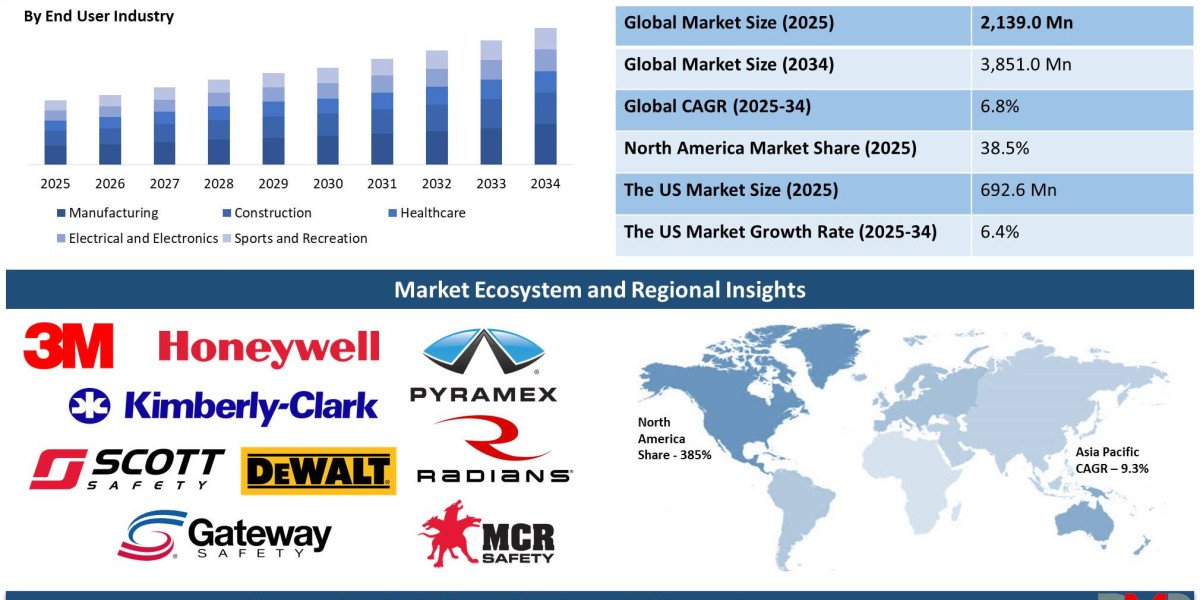
According to Dimension Market Research, the Polycarbonate Safety Glasses Market is expanding as industries strengthen workplace safety practices and increasingly seek protective eyewear that combines durability, comfort, optical clarity, and advanced features. The market was valued at approximately USD 2,139.0 million in 2025 and is projected to reach USD 3,851.0 million by 2034, advancing at a CAGR of 6.8% during the forecast period.
Polycarbonate safety glasses are widely used because their lenses provide strong impact resistance while remaining relatively lightweight. This makes them suitable for workers who require eye protection throughout extended shifts or in environments where flying particles, dust, debris, splashes, or ultraviolet exposure may create hazards.
The market is also evolving beyond basic protective eyewear. Manufacturers are introducing anti-fog coatings, anti-scratch treatments, UV protection, ergonomic frames, prescription-compatible designs, and emerging smart features. These developments are helping protective eyewear become more comfortable, functional, and adaptable to different workplace requirements.
Growing Awareness of Occupational Eye Protection
Workplace eye safety is an important concern across manufacturing, construction, healthcare, laboratories, electrical work, and other professional environments.
Employees may encounter particles, chemicals, dust, sparks, splashes, and mechanical hazards depending on their responsibilities. Appropriate protective eyewear can help reduce exposure to these risks and form part of a broader personal protective equipment program.
Employers are also paying greater attention to employee comfort. Protective glasses that are uncomfortable or difficult to wear can reduce user acceptance.
This is encouraging manufacturers to design safety eyewear that combines protection with fit, ventilation, low weight, and improved optical performance.
Explore the Polycarbonate Safety Glasses Market Report
Why Polycarbonate Lenses Are Popular
Polycarbonate has become a widely used material for protective eyewear because it can provide a strong balance between impact protection and weight.
Protective glasses made with polycarbonate lenses can be suitable for demanding industrial environments while remaining comfortable for regular use.
The material can also accommodate different coatings and treatments. Anti-scratch surfaces can improve durability, while UV protection can expand usability in outdoor environments.
These characteristics give polycarbonate products an advantage across multiple applications.
Manufacturing Remains a Strong End-Use Segment
Manufacturing facilities contain a wide range of equipment and processes that can create potential eye hazards.
Metalworking, machining, cutting, grinding, assembly, maintenance, and chemical processing can all require appropriate protective eyewear.
Polycarbonate safety glasses can provide protection while allowing employees to maintain visibility during detailed tasks.
The expansion of automated manufacturing does not remove the need for PPE. Workers involved in equipment maintenance, quality inspection, production support, and technical operations continue to require appropriate protection.
Construction Activity Supports Demand
Construction is another major demand area.
Workers can encounter dust, drilling fragments, concrete particles, flying debris, and other hazards during building and infrastructure activities.
Safety eyewear can help protect against these risks while supporting clear vision.
Outdoor construction workers may also benefit from UV protection. Combining several features into one product can increase convenience and make advanced eyewear more attractive to contractors and project managers.
Continued investment in residential, commercial, industrial, and infrastructure projects is expected to support long-term demand.
Healthcare and Laboratory Applications
Protective eyewear has an important role in healthcare and laboratory environments.
Healthcare professionals may be exposed to splashes, droplets, and particles during procedures or routine activities. Laboratories can involve chemicals, samples, and processes that require additional eye protection.
Anti-fog performance is especially valuable where face masks or changes in temperature can create condensation on lenses.
Comfort is equally important because medical and laboratory professionals may need to wear protective eyewear for extended periods.
Prescription Safety Eyewear Expands Product Value
Prescription safety glasses provide both vision correction and workplace protection.
This can be particularly beneficial for employees who already require prescription lenses. Instead of using separate conventional glasses and protective eyewear, workers can use an integrated solution.
Prescription-compatible products are relevant across industrial facilities, construction sites, laboratories, medical environments, and technical workplaces.
As employers seek to provide more practical PPE solutions, this segment is expected to remain an important part of product development.
Anti-Fog Technology Improves Visibility
Fogging is a common issue for users of protective eyewear, particularly in humid environments or when face coverings are worn.
Reduced visibility can make it difficult for workers to perform precision tasks safely and efficiently.
Anti-fog coatings help reduce condensation and maintain clearer vision. Manufacturers are therefore investing in improved coating technologies and lens designs.
This feature is particularly relevant to healthcare, manufacturing, construction, laboratories, and other environments where continuous visibility is important.
Anti-Scratch Coatings Increase Durability
Workplace eyewear can be exposed to dust, abrasive materials, rough handling, cleaning agents, and frequent use.
Scratches can reduce visual clarity and shorten product life.
Anti-scratch coatings can improve resistance to surface damage and help lenses remain usable for longer periods.
For companies procuring safety glasses in large quantities, durable products may provide greater lifecycle value by potentially reducing replacement requirements.
UV Protection Supports Outdoor Safety
Employees working outdoors can experience repeated ultraviolet exposure.
Safety glasses with UV-protection features can provide additional protection for construction workers, agricultural employees, utility personnel, infrastructure crews, transportation workers, and other outdoor professionals.
Polycarbonate products that combine impact resistance and UV protection are therefore useful across both industrial and outdoor environments.
The integration of additional protective capabilities is becoming an important area of product differentiation.
Comfort and Ergonomics Influence Adoption
Safety glasses must be worn consistently to provide meaningful protection.
Poor fit, pressure around the ears or nose, excessive weight, and limited ventilation can reduce comfort during long periods of use.
Manufacturers are responding with ergonomic frames, flexible temples, adjustable nose bridges, improved ventilation, and lightweight lens designs.
Comfort-oriented development is particularly important for workplaces where employees spend most of their working day wearing PPE.
Smart Safety Eyewear Emerges
The development of connected personal protective equipment is opening a new area of opportunity.
Smart safety glasses may incorporate sensors and connected technologies to monitor environmental conditions or provide users with additional information.
Potential applications can include exposure monitoring, alerts, communication, and integration with broader workplace safety systems.
Although this technology is still emerging, smart eyewear may eventually become an important product category within the protective-equipment industry.
Digital Purchasing Expands Market Accessibility
The distribution landscape is changing as online purchasing becomes more common.
Traditional industrial distributors remain important because businesses often require bulk procurement, technical assistance, and established supply relationships.
Online channels offer greater accessibility to smaller businesses and individual buyers. Customers can compare specifications, features, protective ratings, and pricing before purchasing.
Manufacturers with both distributor networks and strong digital sales capabilities can reach a wider customer base.
Sustainability Influences Product Design
Sustainability is gradually becoming an important consideration in PPE purchasing.
Manufacturers are exploring longer-lasting products, recyclable materials, and improved production processes.
Durability can contribute to sustainability by reducing how frequently products need to be replaced.
At the same time, recycling polycarbonate presents challenges in some waste streams. Greater attention to responsible disposal and product lifecycle management could influence future product development.
Electrical and Electronics Industry
Electrical and electronics environments require both precision and protection.
Workers may encounter small particles, tools, wires, machinery, and other workplace hazards during assembly, testing, maintenance, and production.
Protective eyewear can provide a safety layer without significantly interfering with visual tasks.
The continued growth of electronics manufacturing and electrical infrastructure is therefore expected to contribute to demand.
Automotive Applications
Automotive manufacturing and repair environments can involve grinding, machining, assembly, painting, maintenance, and other activities that create potential eye hazards.
Safety glasses can help protect workers while allowing them to maintain visibility.
Automotive production facilities are also increasingly automated, meaning employees may work around sophisticated machinery that requires appropriate safety protocols.
As automotive production and service activities expand, demand for reliable protective eyewear can increase.
Distribution Through Industrial Channels
Industrial distributors continue to play an important role because businesses often prefer established suppliers for PPE procurement.
Bulk purchasing can simplify inventory management and ensure that employees receive standardized protective equipment.
Specialized safety retailers also provide access to different product categories and features.
Online channels complement these networks by providing broader product discovery and convenient ordering.
The ability to serve customers through multiple channels can become an important competitive advantage for manufacturers.
North America Maintains Market Leadership
North America is projected to account for approximately 38.5% of market share in 2025, making it the leading regional market.
The region benefits from established manufacturing and construction sectors, developed healthcare infrastructure, strong workplace-safety awareness, and demand for advanced PPE.
The U.S. Polycarbonate Safety Glasses Market is projected to reach USD 692.6 million in 2025 and is expected to rise to USD 1,209.6 million by 2034, growing at a CAGR of 6.4%.
Strong industrial activity and established safety practices provide favorable conditions for continued market expansion.
Asia-Pacific Offers Significant Growth Potential
Asia-Pacific is expected to provide strong future opportunities due to industrialization, construction activity, electronics manufacturing, healthcare investment, and expanding infrastructure.
China and India have large industrial workforces and increasingly modern production environments.
Greater awareness of workplace safety and the implementation of occupational protection practices can encourage higher adoption of certified protective eyewear.
The expansion of manufacturing and construction is likely to make the region increasingly important for global safety-eyewear suppliers.
Europe Focuses on Quality and Worker Protection
Europe has a mature industrial and occupational-safety environment.
Manufacturers and employers increasingly evaluate protective eyewear based on impact performance, comfort, durability, optical quality, and product lifespan.
Advanced coatings and ergonomic designs are therefore relevant to the regional market.
Environmental considerations may also become more influential as businesses seek durable products and more sustainable PPE strategies.
Product Innovation Strengthens Competition
The competitive environment is moving beyond basic eye protection.
Manufacturers are investing in multi-feature products that combine impact resistance, anti-fog performance, scratch resistance, UV protection, improved ventilation, and prescription compatibility.
Innovation can help companies target specific end-use industries and working environments.
Smart eyewear represents an additional avenue for future differentiation as connected PPE technologies develop.
Major Market Challenges
The market faces several challenges despite strong growth prospects.
Premium products can have higher prices due to advanced coatings, specialized frames, prescription capabilities, or integrated smart technologies.
Cost-sensitive customers may select lower-priced alternatives where advanced features are not considered essential.
Competition from other protective-eyewear materials also affects product selection.
Manufacturers therefore need to maintain a balance between safety, performance, comfort, durability, innovation, and affordability.
Competitive Landscape
The market includes major PPE manufacturers, safety-equipment suppliers, and specialized eyewear companies.
Major participants identified by Dimension Market Research include 3M, Honeywell, Scott Safety, DEWALT, Radians, MCR Safety, Gateway Safety, Kimberly-Clark, MSA, Pyramex, Bollé Safety, Uvex Safety Group, and Dursafety.
Companies compete through product quality, protective performance, pricing, distribution networks, design innovation, and customer support.
Expanding product portfolios and specialized solutions are becoming important strategies for maintaining market position.
Recent Innovation and Industry Activity
The industry continues to introduce products that combine multiple protective functions.
Pyramex has focused on lightweight safety eyewear incorporating features such as UV protection and anti-fog performance, reflecting growing demand for multifunctional products.
Manufacturers are also investing in production expansion and strategic partnerships to strengthen their ability to serve construction, industrial, and professional customers.
Such developments demonstrate the continued evolution of the protective-eyewear market.
Future Trends
Future product development is expected to focus on comfort, advanced materials, improved coatings, and connected safety technologies.
Anti-fog and anti-scratch features will remain important because visibility and durability directly affect user experience.
Prescription safety glasses should continue to serve workers requiring vision correction, while lightweight and ergonomic designs will support longer wear.
Smart protective eyewear may gradually expand as sensor technologies and workplace connectivity become more accessible.
Sustainability is also likely to influence product design through durability, material selection, and lifecycle considerations.
Market Outlook
According to Dimension Market Research, the Polycarbonate Safety Glasses Market is projected to grow from USD 2,139.0 million in 2025 to USD 3,851.0 million by 2034, representing a 6.8% CAGR.
Manufacturing and construction are expected to remain major demand sources, while healthcare, electronics, laboratories, automotive, and outdoor applications will provide additional opportunities.
North America is projected to remain the leading regional market, while Asia-Pacific is expected to experience strong expansion.
The combination of workplace safety requirements, product innovation, user comfort, and advanced protective features will continue shaping the market.
Buy the Complete Polycarbonate Safety Glasses Market Report
Conclusion
The Polycarbonate Safety Glasses Market is evolving as businesses increasingly recognize that effective eye protection must combine safety with comfort, durability, and practical functionality.
Polycarbonate remains a preferred lens material because of its lightweight construction and strong impact resistance. Anti-fog coatings, anti-scratch surfaces, UV protection, prescription designs, ergonomic frames, and emerging smart technologies are broadening product capabilities.
North America currently leads the market, while Asia-Pacific offers significant long-term growth potential as industrial activity and workplace-safety awareness increase.
With the market projected to reach USD 3.85 billion by 2034, protective eyewear manufacturers have substantial opportunities to develop products that meet the changing needs of modern workplaces.